Chapter 11: Short-Form Algorithm Mastery — Hooks, Interrupts & Viral Loops
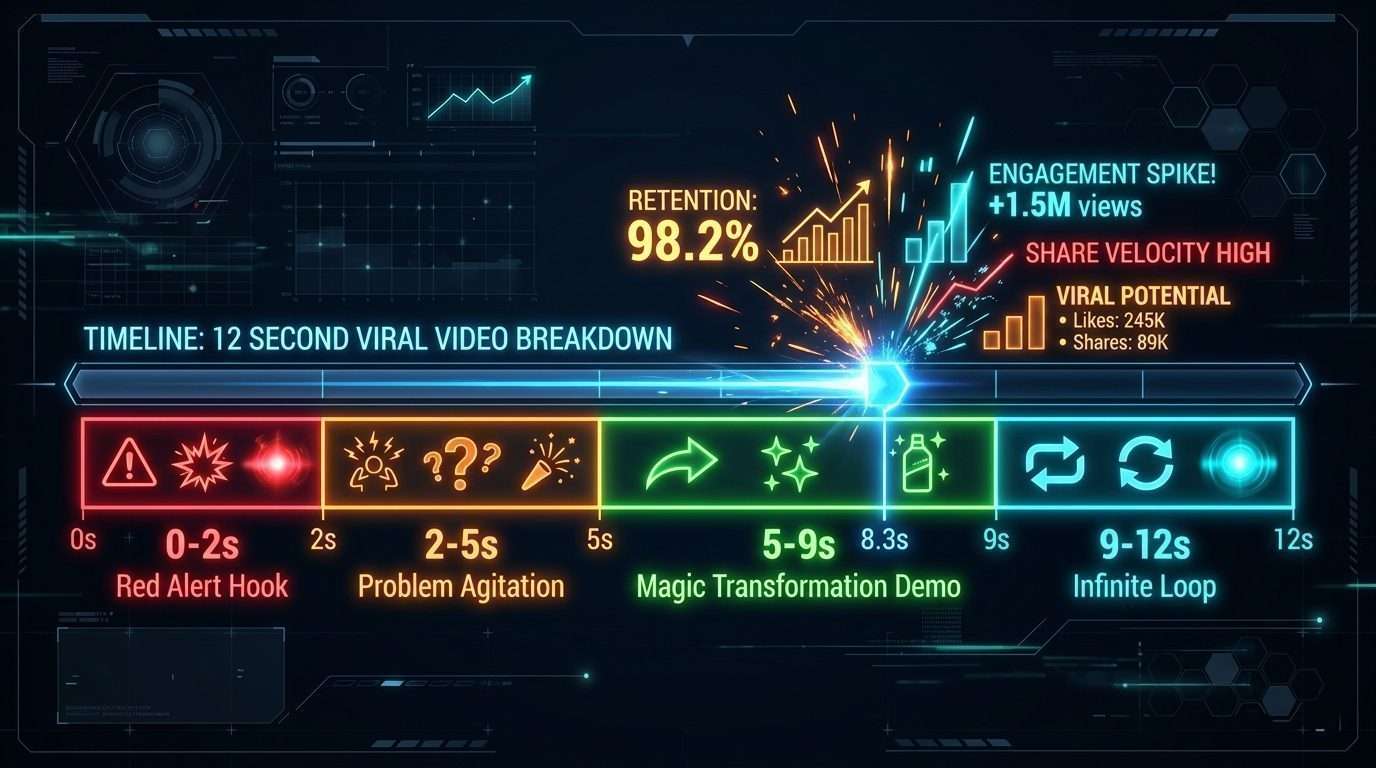
The algorithm governing modern short-form video (TikTok, Instagram Reels, YouTube Shorts) is not a mystery; it is a mathematical feedback loop optimized for two primary metrics: Watch Time Percentage and Re-watch Velocity.
If 70% of viewers swipe away during the first 2 seconds, the algorithm immediately throttles the video’s distribution. If 60% of viewers watch an 11-second video to the very end—and 25% loop it a second time—the algorithm distributes that video to millions of user feeds.
To drive 50,000 to 200,000 app installs per month organically, you must master the structural physics of viral short-form video.
⏱️ The 12-Second Viral Physics Blueprint:
• 0.0s – 1.5s: 🔴 The Visual Pattern Interrupt (Stop the scrolling thumb cold)
• 1.5s – 5.0s: 🟠 The Problem Agitation (Create acute emotional or workflow tension)
• 5.0s – 9.0s: 🟢 The Magic Demo (Demonstrate instant 1-tap software resolution)
• 9.0s – 12.0s: 🔵 The Seamless Loop / CTA (Hook connects back to the start)
The Anatomy of the 1.5-Second Pattern Interrupt
The first 1.5 seconds of your video must shatter the viewer’s passive scrolling trance. Never start with: “Hey guys, today I want to show you an app I made…” (Instant swipe).
Use these three proven Visual Pattern Interrupt Hooks:
1. The Screen-Mirror Contrast Hook
Show an over-the-shoulder recording of someone struggling with a tedious physical task (e.g., typing numbers manually into Excel), followed by a hand entering the frame and pointing a phone at the screen, which solves it in 0.5 seconds.
2. The Controversial Comparison Hook
- “Stop using [Heavy Legacy Tool]. It is literally wasting 2 hours of your week.”
- “Why is nobody talking about this 1-second shortcut?”
3. The “Secret Feature” Hook
- “If you have an iPhone and you aren’t doing this, you’re missing out…”
The 4 Viral Video Formats That Drive Massive App Downloads
📱 Format 1: The Raw Screen Recording with ASMR Audio
Crisp UI taps, satisfying haptic audio clicks, zero voiceover, ultra-clean aesthetic execution.
🛠️ Format 2: The “Building in Public” Problem Breakdown
“I was tired of [Frustrating Manual Problem], so I spent 3 days vibe-coding a 1-tap solution…”
⚡ Format 3: The Side-by-Side Race (Manual vs. App)
Split screen: Left side completes the chore manually (takes 60s); Right side taps the app button (takes 2s).
📊 Format 4: The Shocking Data Output
Pointing the camera at something common (e.g., a food plate, a receipt, a code block) to reveal an immediate, unexpected AI breakdown.
The Seamless Infinite Loop Hack
Short-form platforms calculate completion rate using a simple mathematical formula:
💡 The Retention Multiplier Formula:
Retention Rate (%) =(Total Seconds Watched ÷ Total Video Length)× 100%
If a video is 10 seconds long and a viewer watches it twice because the ending sentence connects seamlessly into the opening hook, your retention rate is 200%. This triggers maximum algorithmic velocity.
How to Engineer an Infinite Loop:
- End the video sentence mid-thought: “…and that is the exact reason why…”
- Begin the opening text/hook with the completion: “This one hidden trick changes everything.”
App Store Link Architecture: Zero-Friction Routing
Never put friction between viral video curiosity and App Store installation:
- The Smart Redirect Domain: Use a clean, instant-redirect domain (e.g.,
get[appname].com) that automatically detects iOS vs. Android user-agents and routes directly into the native App Store. - The Pinned Comment Strategy: Pin a comment explaining the exact name of the app within 60 seconds of posting. High-intent viewers check the top comment first.
Execution Rule: Consistency beats perfection. Post 2 to 3 native variations per day. Out of 20 videos, 16 will get 1,000 views, 3 will get 50,000 views, and 1 will hit 2,000,000 views—driving 15,000 installs in 48 hours.
For Better Reading Experience Buy Kindle Book
Sanjeev Kumar
Founder & Lead Engineer at PrepNew. Building cross-platform Flutter applications, serverless AI backends, and full-stack Dart web architectures.