Chapter 1: The Pain-Point Arbitrage — Spotting High-Intent Micro-Problems

The number one reason first-time software entrepreneurs fail is not broken code, bad design, or server downtime. It is building something nobody desperately wants.
Most novice builders make the fatal mistake of brainstorming in a vacuum:
- “What if I built a social network for book lovers?”
- “What if I built a gamified task manager with RPG swords?”
- “What if I built an AI diary that analyzes dreams?”
When you build from imagination rather than market evidence, you spend months engineering software that results in zero downloads, zero subscribers, and immediate founder burnout.
Experienced solopreneurs practice Pain-Point Arbitrage: finding where people are already struggling, complaining, and spending money on clumsy, manual workarounds—and replacing that friction with a dedicated, one-tap mobile utility.
🔴 Low-Intent Idea (Brainstormed in Vacuum)
“Wouldn’t it be fun if an app did X?”
➔ Perception: Low perceived urgency & nice-to-have curiosity.
➔ Result: Poor conversion ➔ High CAC ➔ 90% Churn.
🟢 High-Intent Arbitrage (Mined from Market Friction)
“I waste 2 hours every Sunday formatting receipts for tax compliance.”
➔ Perception: Immediate time-saving & financial relief.
➔ Result: High urgency ➔ Instant $9.99/wk Subscription.
The Three Hallmarks of a High-Intent Micro-Pain
To build an application that reliably hits $10,000 to $100,000/month as a solo developer, your target problem must meet three strict structural criteria:
1. High Emotional or Financial Cost of Inaction
- The Market Friction: The user experiences immediate anxiety, financial waste, or physical discomfort if the problem is unsolved today.
- The Solopreneur Advantage: High emotional urgency drives instant in-app purchase conversion during the first session without requiring long email sales drips.
2. The Compressible Workflow Requirement
- The Market Friction: The workflow currently requires 4 to 6 clumsy, manual steps across spreadsheets, browser tabs, paper notebooks, or physical calculators.
- The Solopreneur Advantage: You replace a multi-step chore with a single dedicated 1-tap mobile utility, delivering a 10x UX improvement.
3. The 30-Second “Aha!” Value Delivery
- The Market Friction: Complex enterprise tools take days to configure before delivering tangible results.
- The Solopreneur Advantage: The user experiences the core magic within 30 seconds of completing the onboarding survey, triggering immediate dopamine before the paywall appears.
Real-World Case Study: The High-Intent Cessation Engine
Case Study: Stoppr (Habit & Addiction Cessation)
- App URL: stoppr.app
- Financial Metric: Scaled to $12,000+/month MRR within weeks of launch.
- The Opportunity: Millions of people desperately want to quit vaping or smoking, but legacy apps were boring calendars with generic countdown timers.
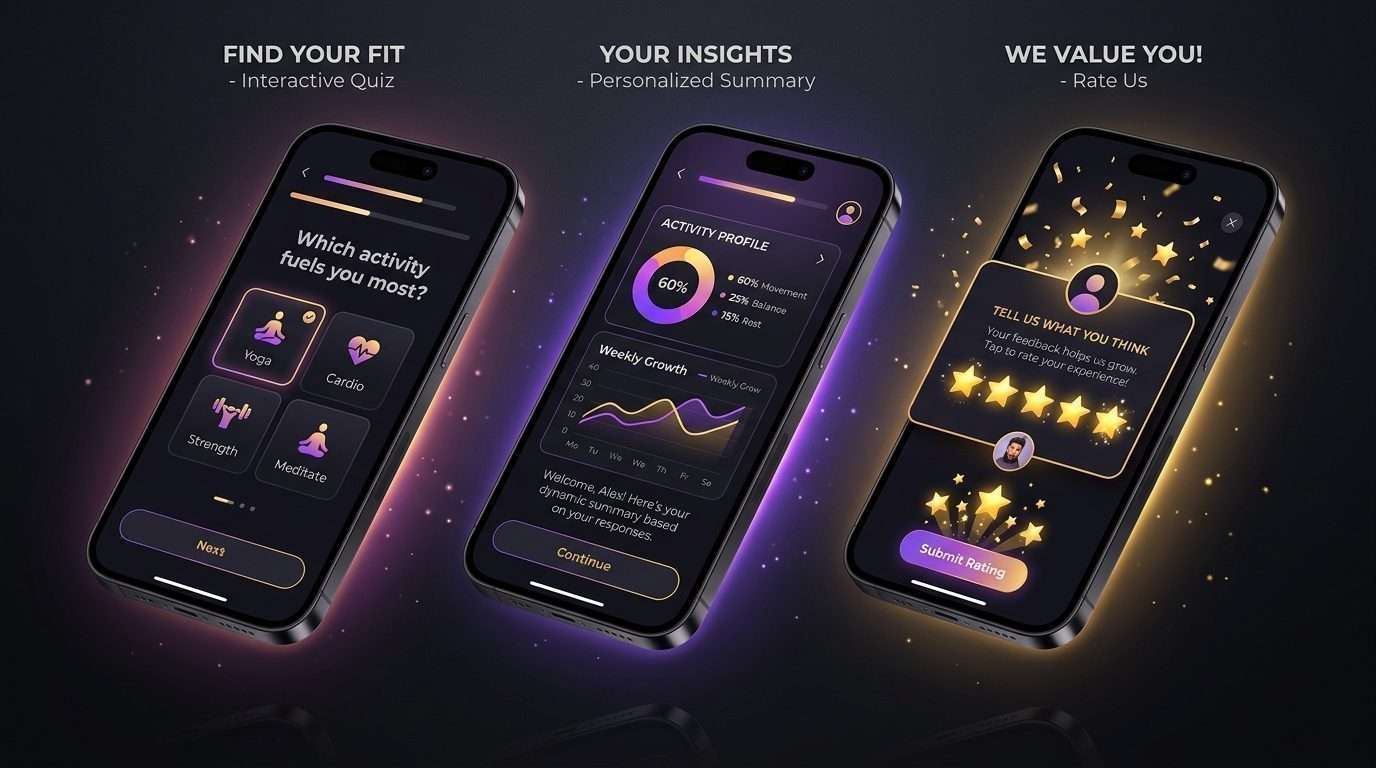
- The Arbitrage: Stoppr paired an intense, high-emotion diagnostic onboarding survey (“How many cigarettes do you smoke a day? How much money have you lost this year?”) with real-time financial savings tracking, lung regeneration metrics, and emergency panic-button craving relief.
- The Tech Stack:
- Client Framework: React Native / Expo
- In-App Purchase Infrastructure: RevenueCat (Weekly subscription with 3-day trial)
- Local Database: WatermelonDB (Local-first state for instant offline latency)
- Analytics: Mixpanel (Tracking exact onboarding drop-off points)
The 3 Digital Goldmines: Where to Mine Validated Demand
Instead of guessing, use these three systematic intelligence vectors to discover validated customer demand:
- 🌐 Vector 1: Niche Forum Communities: Filter Reddit and Discord by “How do I…” & “Why is there no tool for…”
- ⭐ Vector 2: App Store Review Mining: Filter competitor 2-star & 3-star reviews for “I wish this app had…”
- 🔍 Vector 3: High-Growth Search Intent: Filter search auto-suggest for “app for [specific niche problem]”
1. The High-Intent Forum Search Strings
Navigate to targeted sub-communities and search for exact problem-identifying queries:
"Is there any lightweight app that just does [Task] without a subscription?""I built a custom Google Sheet for [Workflow] because every software out there is bloated""Tired of paying $50/month for [Enterprise SaaS] when I only use this one feature"
When a community member shares a complex spreadsheet or a custom Python script they wrote to solve their own problem, they have handed you a validated micro-SaaS on a silver platter.
2. The 3-Star Review Sweet Spot
Navigate to top-grossing apps in your candidate category and filter strictly for 2-star and 3-star reviews:
- 1-star reviews are mostly irrational complaints (“My phone died” or “Hate this app”).
- 5-star reviews provide no product critique (“Great!”).
- 2-star and 3-star reviews are written by engaged, paying customers who love the core premise but are infuriated by a specific flaw.
Look for patterns like:
“I love tracking my climbing grades, but the app forces me through 6 menus just to log one boulder problem.”
“The AI transcription is great, but it doesn’t format into bullet points for my clinical notes.”
The Micro-App Opportunity Scoring Matrix
Before writing a single line of code, score your candidate app concept across four objective dimensions:
1. Urgency of Pain
- 🔴 1 Point (Red Flag): Casual entertainment; “nice to have” with zero daily consequence.
- 🟡 3 Points (Moderate): Weekly annoyance or minor inconvenience.
- 🟢 5 Points (Green Light): Acute daily pain, immediate anxiety, or direct financial loss.
2. Time to First Value (“Aha!” Speed)
- 🔴 1 Point (Red Flag): > 3 minutes (requires tutorials, account verification, and complex setup).
- 🟡 3 Points (Moderate): 1 to 2 minutes.
- 🟢 5 Points (Green Light): < 30 seconds (instant camera scan, 1-tap audio capture, immediate result).
3. Visual Virality & Demonstrability
- 🔴 1 Point (Red Flag): Abstract text dashboard; difficult to demonstrate in a 5-second video.
- 🟡 3 Points (Moderate): Standard UI utility with mild visual appeal.
- 🟢 5 Points (Green Light): Shocking before-and-after visual contrast or instant visual transformation.
4. Maintenance Drag & Automation
- 🔴 1 Point (Red Flag): Requires daily manual data curation, customer support, or complex ops.
- 🟡 3 Points (Moderate): Moderate API reliance and occasional schema updates.
- 🟢 5 Points (Green Light): 100% automated client-side or serverless AI pipeline.
🎯 Scoring Decision Guideline:
• 16 – 20 Points: 🟢 Immediate 7-Day MVP Build Candidate (Green Light)
• 12 – 15 Points: 🟡 Requires tighter niche down-scoping before building
• Below 12 Points: 🔴 Discard immediately. Do not waste engineering cycles.
💡 Core Takeaway: Your job as a solo builder is not to invent new human desires. Your job is to identify existing desires and provide a 10x faster, zero-friction interface to fulfill them.
For Better Reading Experience Buy Kindle Book
Viral App Playbook
Sanjeev Kumar
Founder & Lead Engineer at PrepNew. Building cross-platform Flutter applications, serverless AI backends, and full-stack Dart web architectures.